Bone Health
Sep 28, 2026
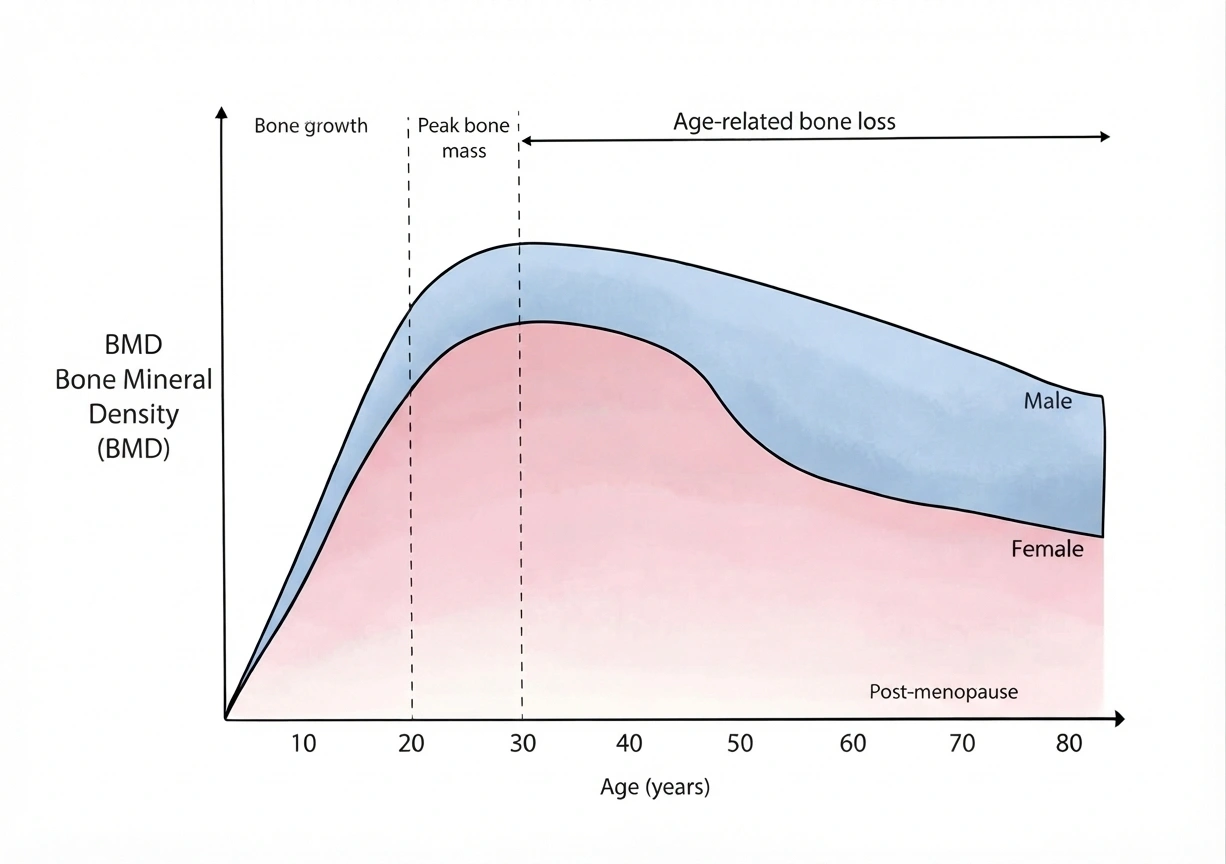
Bone is living tissue. Throughout our lives it is constantly being broken down and rebuilt at the same time, a process called remodelling. Certain life events can tip this balance, and menopause is a big one. The drop in estrogen that comes with it has been linked to osteoporosis (Tella & Gallagher, 2014), which helps explain why osteoporosis affects 23% of Australian women over 50 compared with just 6% of men (Australian Institute of Health and Welfare, 2014).
The rate of bone loss after menopause is also striking. Postmenopausal women lose around 0.6% of their bone per year in their 60s, 1.1% in their 70s, and 2.1% per year after 80 (Gómez-Cabello et al., 2012). If you needed a reason to keep reading, that's it and if not, have another look at the decline in your bone over your life in the graph.
So how does lower estrogen affect bone?
Part of estrogen's job is to keep the cells that break down bone (osteoclasts) in check. With less estrogen, these cells can work for longer and at a higher capacity (Khosla et al., 2012). Estrogen also appears to protect our bone builders (osteoblasts) by reducing their death rate and extending their lifespan (Khosla et al., 2012). Put together, breakdown speeds up while rebuilding can't keep pace, which leaves us more prone to low bone mineral density (BMD) and osteoporosis. There are likely other mechanisms at play, but this gives you a good picture of why estrogen matters.
You might wonder whether hormone replacement therapy could help in the early stages of low BMD. That's outside my scope of practice, but it's a worthwhile conversation to have with your doctor. What I can tell you is what has a proven, positive effect on bone: exercise. Why is this? Because bones react and adapt to loads placed on the body through exercise (Santos et al., 2017).
Are you doing enough?
It's well known that exercise is good for bone, but not all exercise is equal. We've all heard that impact matters, yet lower-impact activities like walking, on their own, may not provide enough stimulus to meaningfully increase BMD (Benedetti et al., 2018). That doesn't make walking any less valuable for your overall health and for reducing chronic disease risk (Lee & Buchner, 2008), so please keep up your daily walks.
What does the research say?
Benedetti et al. (2018) reviewed 18 systematic reviews and meta-analyses and found that:
Bone responds best to high loads with low repetitions.
Progressive resistance training (lower limb) produced the best results for BMD at the hip (femoral neck).
Higher-impact aerobic training (jogging, stair climbing, stepping) can help slow BMD loss in some cases, but on its own it didn't increase BMD.
Multicomponent training (a mix of aerobic, strength, progressive resistance, balance and dance) also showed benefits. However, the studies varied so much that the ideal duration, frequency and combination remain unclear.
In short: high-load resistance training works, multicomponent and high-impact training may work in certain situations, and low-level aerobic exercise alone is unlikely to be optimal.
What does this look like in practice?
Exercise and Sports Science Australia (ESSA) gives more specific guidance in its position statement, combining recommendations into three components (Beck et al., 2016):
Impact loading, such as jumping, hopping and bounding, 4-7 days per week (around 50 repetitions, divided into sets of 5-20 depending on your level of risk)
Progressive resistance training, 2-3 sets of 8 repetitions at 80-85% of your one-rep max, 2 days per week. The weight should feel "very heavy", with the last few reps of each set feeling challenging, plus the weight must increase over time (this training level is very similar to positive findings from Bendetti et al (2018), where the beneficial effects from the studies ranged from 2-3 sets, 70-90%, 8-10 repetitions, 3 times per week). It should also be noted that improving BMD is site-specific, meaning if you want to improve whole-body BMD or high risk fracture locations you must target the muscles around those areas (Bendetti et al., 2018)
Balance training, for some people, four times per week for 30 minutes.
If you don't currently exercise much, that can sound like a lot. Remember that this is the gold standard for bone health. It doesn't account for your exercise history or any other health conditions, so it isn't where everyone should start. If you'd like a program that's chosen and dosed for your individual needs, give us a call and we can book you in for a consult.
References
Australian Institute of Health and Welfare. (2014). Estimating the prevalence of osteoporosis in Australia. Australian Government. https://www.aihw.gov.au/reports/chronic-musculoskeletal-conditions/estimating-the-prevalence-of-osteoporosis-in-austr/summary
Beck, B. R., Daly, R. M., Fiatarone Singh, M. A., & Taaffe, D. R. (2016). Exercise and Sports Science Australia (ESSA) position statement on exercise prescription for the prevention and management of osteoporosis. Journal of Science and Medicine in Sport. http://dx.doi.org/10.1016/j.jsams.2016.10.001
Benedetti, M. G., Furlini, G., Zati, A., & Mauro, G. L. (2018). The effectiveness of physical exercise on bone density in osteoporotic patients. BioMed Research International, 2018. https://doi.org/10.1155/2018/4840531
Gómez-Cabello, A., Ara, I., González-Agüero, A., Casajús, J. A., & Vicente-Rodríguez, G. (2012). Effects of training on bone mass in older adults: A systematic review. Sports Medicine, 42(4), 301–325. https://doi.org/10.2165/11597670-000000000-00000
Khosla, S., Oursler, M. J., & Monroe, D. G. (2012). Estrogen and the skeleton. Trends in Endocrinology & Metabolism, 23(11), 576–581. https://doi.org/10.1016/j.tem.2012.03.008
Santos, L., Elliott-Sale, K. J., & Sale, C. (2017). Exercise and bone health across the lifespan. Biogerontology, 18(6), 931-946. https://doi.org/10.1007/s10522-017-9732-6
Tella, S. H., & Gallagher, J. C. (2014). Prevention and treatment of postmenopausal osteoporosis. The Journal of Steroid Biochemistry and Molecular Biology, 142, 155–170. https://doi.org/10.1016/j.jsbmb.2013.09.008